
Crisis Leadership
How the Best Leaders Balance Head and Heart Under Pressure
Crisis Leadership, as defined by Dynamic Results, is the discipline of leading people through high-pressure situations with clarity, accountability, and focused action. It applies when the stakes are high, the facts are incomplete, and the cost of delay is real.
Crisis Leadership is not a separate leadership philosophy. It is the high-stakes application of the work Dynamic Results does through Winning with Accountability™, Emotional Safety®, and Strategy Execution. A crisis does not create a leadership culture. It exposes the one that was already there.

The Four Questions That Determine Crisis Outcomes
Every crisis, regardless of its nature, forces leaders to answer four questions. The speed and accuracy with which leaders answer them determines whether the organization stabilizes and moves forward, or stalls and sustains avoidable damage.
- What is actually happening? Leaders must cut through noise, fear, assumptions, and internal politics to see reality clearly. Not the story people are comfortable telling. Reality. This requires the kind of Emotional Safety® that makes honest reporting possible even when the truth is uncomfortable.
- What matters most right now? Attention and resources must move to the few things that will stabilize the situation and advance the organization. Everything else waits. This is disciplined prioritization under conditions where the pressure to address everything simultaneously is intense.
- Who owns what? Role clarity and decision clarity must be established quickly. Ambiguity is expensive in a crisis. Leaders need to build a culture of accountability in advance so they can quickly establish ownership when the situation becomes urgent.
- How do we keep people moving without letting emotion override execution? Leaders must create Emotional Safety® for people to speak honestly, while maintaining enough accountability to act decisively on what they hear. Crisis Leadership teaches leaders how to hold both at the same time.
What Crisis Leadership Delivers
- Clearer thinking. Leaders learn to separate signal from noise, facts from assumptions, and urgent activity from meaningful action. Clearer thinking produces fewer reactive decisions and faster movement toward resolution.
- Faster alignment. Misalignment is expensive in a crisis. Crisis Leadership gives teams a shared framework to stabilize, prioritize, and act without waiting for perfect information or full consensus.
- Stronger accountability. Crisis exposes weak accountability systems. Crisis Leadership helps leaders create ownership without blame and urgency without chaos, turning pressure into focused action rather than defensive behavior.
- Greater Emotional Safety®. People do not surface risk or tell hard truths when they feel unsafe. Crisis Leadership helps leaders create the conditions for honest communication while maintaining the discipline to act decisively on what they hear.
- Execution when the plan breaks. Crisis Leadership connects decision-making to action in real time. It is about moving the right people toward the right outcomes at the right speed, even when the original strategy no longer applies.
What Crisis Leadership Is Not
- Not crisis management. Crisis management handles process, protocol, communications, and compliance systems. Crisis Leadership addresses the human leadership behaviors that determine whether those systems actually work.
- Not command-and-control. It requires clarity and decisiveness, but also truth-telling, distributed ownership, and the kind of trust that only Emotional Safety® can produce. Autocratic leadership in a crisis creates silence. Silence creates damage.
- Not a soft framework. It is not empathy instead of execution. It is emotional clarity in service of execution. It recognizes that when people are afraid or avoidant, performance suffers, and addresses the root cause rather than the symptom.
How Crisis Leadership Connects to the Full Dynamic Results Framework
Crisis Leadership is the integrating framework that brings Winning with Accountability™, Emotional Safety®, and Strategy Execution together under the conditions where all three are most needed and most likely to break down.
Winning with Accountability™ builds ownership and follow-through in everyday leadership. Under Crisis Leadership, that accountability system is tested under real pressure. Emotional Safety® creates the trust environment for honest communication. Under Crisis Leadership, it is applied in the moments when truth is most needed and most likely to be suppressed. Strategy Execution keeps disciplined action alive when the plan breaks.
Crisis Leadership is the capstone application of the Dynamic Results body of work.
Frequently Asked Questions
What is crisis leadership?
Crisis leadership is the practice of leading effectively through disruption, sudden change, or high-pressure situations. Dynamic Results frames it around a central tension: the need for clear, fast, strategic decisions (head) balanced with genuine empathy for the people affected by those decisions (heart).
What does it mean to lead with head and heart during a crisis?
Leading with head and heart means making hard decisions clearly and quickly while also acknowledging their human impact, and staying visible and present with your team rather than retreating into planning mode during a disruption.
How does Dynamic Results help leaders navigate organizational crises?
Dynamic Results draws on real conversations with leaders who have navigated significant crises to help executives build the underlying capability to hold strategic clarity and empathy at the same time, so they are equipped for whatever form the next disruption takes.
What is the difference between crisis management and crisis leadership?
Crisis management typically refers to the operational and logistical response to a disruption. Crisis leadership, as Dynamic Results uses the term, is about how leaders show up for their people during that response, balancing decisive action with empathy to maintain trust.
How does crisis leadership connect to Emotional Safety at Dynamic Results?
A crisis is when people are most likely to hold back bad news. Leaders who have built Emotional Safety® into their teams before a crisis are more likely to receive honest, timely information during one, which often determines how quickly an organization recovers.
Who is Henry Evans?
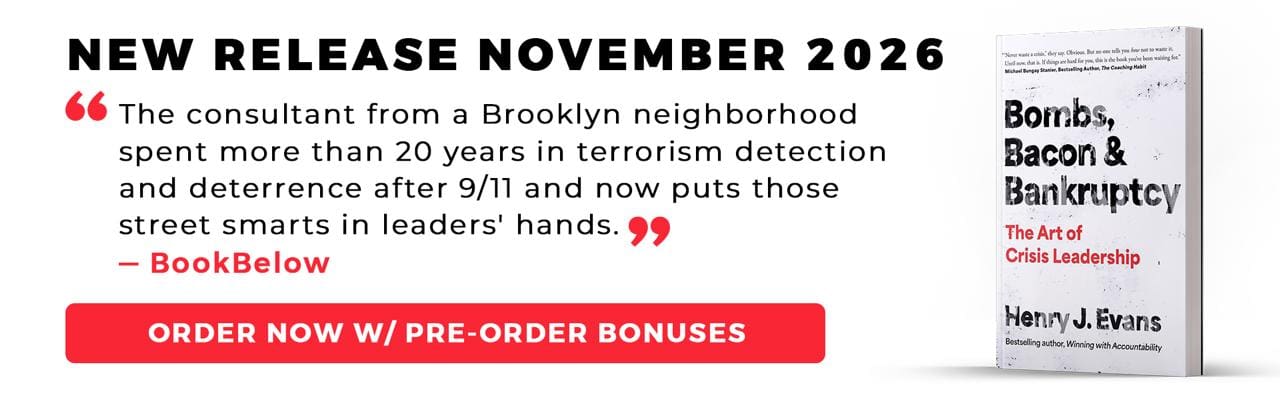
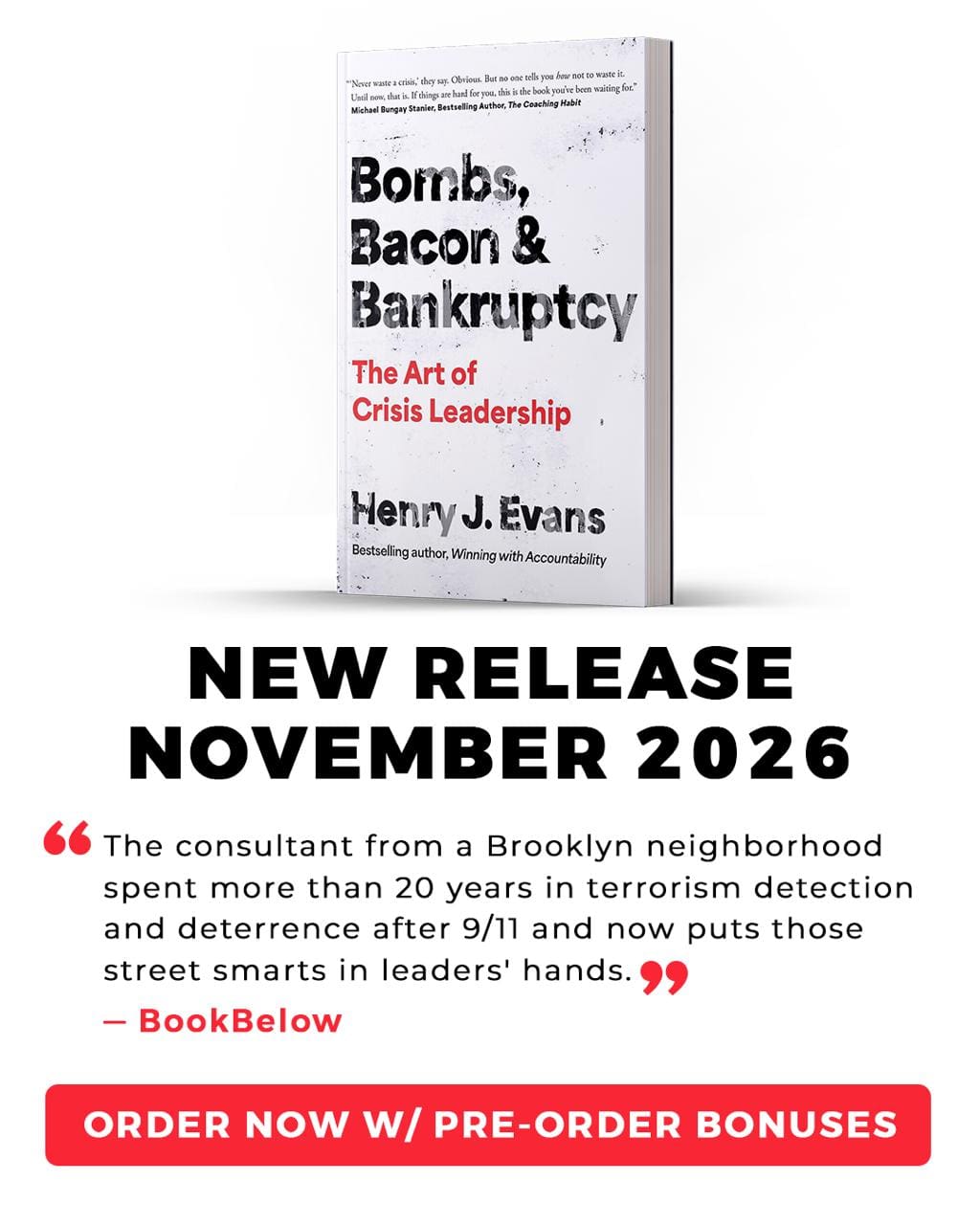
Henry Evans is the founder of Dynamic Results and the author of Winning with Accountability. He is also the co-creator, with Dr. Colm Foster, of the Emotional Safety® framework. His forthcoming book, Bombs, Bacon, and Bankruptcy: The Art of Crisis Leadership, merges more than 20 years of classified counterterrorism work with 16,000-plus hours of executive coaching to deliver a definitive field manual for leaders navigating disruption. The book releases November 10, 2026, and is available for pre-order at henryjevans.com.